Nimra soomro
2k17/BEDEL/77
Types Of Motivation (intrinsic and extrinsic)
Intrinsic Motivation:

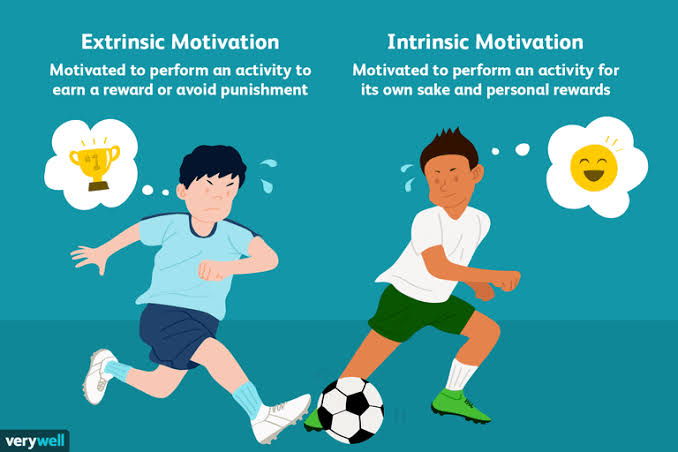
Intrinsic motivation refers to behavior that is driven by internal rewards. In other words, the motivation to engage in a behavior arises from within the individual because it is naturally satisfying to you. This contrasts with extrinsic motivation, which involves engaging in a behavior in order to earn external rewards or avoid punishment.
Understanding Intrinsic Motivation
In psychology, intrinsic motivation distinguishes between internal and external rewards. In “Introduction to Psychology: Gateways to Mind and Behavior With Concept Maps,” the authors offer this definition:
“Intrinsic motivation occurs when we act without any obvious external rewards. We simply enjoy an activity or see it as an opportunity to explore, learn, and actualize our potentials.”
The Internal Satisfaction
When you pursue an activity for the pure enjoyment of it, you are doing so because you are intrinsically motivated. Your motivations for engaging in the behavior arise entirely from within rather than out of a desire to gain some type of external rewards such as prizes, money, or acclaim.
Of course, that isn’t to say that intrinsically motivated behaviors do not come with their own rewards. These rewards involve creating positive emotions within the individual.
Activities can generate such feelings when they give people a sense of meaning like participating in volunteer or church events. They may also give you a sense of progress when you see that your work is accomplishing something positive or competence when you learn something new or become more skilled at a task.
Intrinsic Rewards and Motivation
Researchers have discovered that offering external rewards or reinforcements for an already internally rewarding activity can actually make the activity less intrinsically rewarding. This phenomenon is known as the overjustification effect.
“A person’s intrinsic enjoyment of an activity provides sufficient justification for their behavior,” explains author Richard A. Griggs in his book “Psychology: A Concise Introduction.” “With the addition of extrinsic reinforcement, the person may perceive the task as overjustified and then attempt to understand their true motivation (extrinsic versus intrinsic) for engaging in the activity.
It is also suggested that people are more creative when they are intrinsically motivated.
In work settings, for instance, productivity can be increased by using extrinsic rewards such as a bonus. However, the actual quality of the work performed is influenced by intrinsic factors. If you are doing something that you find rewarding, interesting, and challenging, you are more likely to come up with novel ideas and creative solutions.
Motivation to Learn
Intrinsic motivation is an important topic in education. Teachers and instructional designers strive to develop learning environments that are intrinsically rewarding. Unfortunately, many traditional paradigms suggest that most students find learning boring so they must be extrinsically goaded into educational activities.
In “Making Learning Fun: A Taxonomy of Intrinsic Motivations for Learning,” authors Thomas Malone and Mark Leeper suggest that this does not need to be the case. They identify several different ways to make learning environments that are intrinsically rewarding.
The authors define activities as intrinsically motivating if “people engage in it for its own sake, rather than in order to receive some external reward or avoid some external punishment. We use the words fun, interesting, captivating, enjoyable, and intrinsically motivating all more or less interchangeably to describe such activities.”
The factors they identify as increasing intrinsic motivation include:
Challenge: People are more motivated when they pursue goals with personal meaning and when attaining the goal is possible but not necessarily certain. These goals may also relate to their self-esteem when performance feedback is available.
Curiosity: Internal motivation is increased when something in the physical environment grabs the individual’s attention (sensory curiosity). It also occurs when something about the activity stimulates the person to want to learn more (cognitive curiosity).
Control: People want control over themselves and their environments and want to determine what they pursue.
Cooperation and competition: Intrinsic motivation can be increased in situations where people gain satisfaction from helping others. It also applies to cases where they are able to compare their own performance favorably to that of others.
Recognition: People enjoy having their accomplishment recognized by others, which can increase internal motivation.
Extrinsic motivation:

Extrinsic motivation refers to behavior that is driven by external rewards such as money, fame, grades, and praise. This type of motivation arises from outside the individual, as opposed to intrinsic motivation, which originates inside of the individual.
How Effective Is Extrinsic Motivation?
So just how well do extrinsic rewards work for increasing motivation? This type of motivation can be highly effective. Just look at all of the examples in your own life of things that you do in order to gain some type of external reward. You might shop with a store loyalty card in order to gain points, discounts, and prizes. You might toil away performing tasks at work that you dislike in order to keep getting a steady paycheck. You might even use a particular type of credit card in order to receive airline miles.
All of these are examples of performing specific behaviors in order to obtain an external reward.
est in performing the activity or in cases where basic skills are lacking, but these rewards should be kept small and should be tied directly to performing a specific behavior. Once some intrinsic interest has been generated and some essential skills have been established, the external motivators should be slowly phased out.
A Word From Verywell
Extrinsic motivation can exert a powerful influence on human behavior, but as research on the overjustification effect shows, it has its limits. You might also find it helpful to consider whether you are intrinsically or extrinsically motivated when engaging in certain activities. Are you looking forward to your workout at the gym because you have a bet with a friend about who can lose the most weight? Then you are extrinsically motivated. If, on the other hand, you are eager to work out because you find the activity fun and satisfying, then you are intrinsically motivated.
Extrinsic motivation is not a bad thing. External rewards can be useful and effective tool for getting people to stay motivated and on task. This can be particularly important when people need to complete something that they find difficult or uninteresting, such as a boring homework assignment or a tedious work-related project.
Best example of intrinsic and extrinsic motivation
 gardner.video.blog