Social learning Theory.
In social learning theory, Albert Bandura (1977) agrees with the behaviorist learning theories of classical conditioning and operant conditioning. However, he adds two important ideas
SLT is often described as the ‘bridge’ between traditional learning theory (i.e., behaviorism) and the cognitive approach. This is because it focuses on how mental (cognitive) factors are involved in learning.
Unlike Skinner, Bandura (1977) believes that humans are active information processors and think about the relationship between their behavior and its consequences. Observational learning could not occur unless cognitive processes were at work. These mental factors mediate (i.e., intervene) in the learning process to determine whether a new response is acquired.
Therefore, individuals do not automatically observe the behavior of a model and imitate it. There is some thought prior to imitation, and this consideration is called mediational processes. This occurs between observing the behavior (stimulus) and imitating it or not (response)
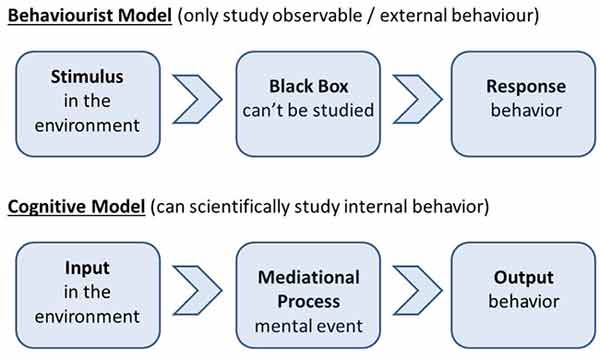
There are four mediational processes proposed by Bandura:
- Attention: The extent to which we are exposed/notice the behavior. For a behavior to be imitated, it has to grab our attention. We observe many behaviors on a daily basis, and many of these are not noteworthy. Attention is therefore extremely important in whether a behavior influences others imitating it.
- Retention: How well the behavior is remembered. The behavior may be noticed but is it not always remembered which obviously prevents imitation. It is important therefore that a memory of the behavior is formed to be performed later by the observer.Much of social learning is not immediate, so this process is especially vital in those cases. Even if the behavior is reproduced shortly after seeing it, there needs to be a memory to refer to.
- Reproduction: This is the ability to perform the behavior that the model has just demonstrated. We see much behavior on a daily basis that we would like to be able to imitate but that this not always possible. We are limited by our physical ability and for that reason, even if we wish to reproduce the behavior, we cannot.This influences our decisions whether to try and imitate it or not. Imagine the scenario of a 90-year-old-lady who struggles to walk watching Dancing on Ice. She may appreciate that the skill is a desirable one, but she will not attempt to imitate it because she physically cannot do it.
- Motivation: The will to perform the behavior. The rewards and punishment that follow a behavior will be considered by the observer. If the perceived rewards outweigh the perceived costs (if there are any), then the behavior will be more likely to be imitated by the observer. If the vicarious reinforcement is not seen to be important enough to the observer, then they will not imitate the behavior.
 gardner.video.blog