Howard Gardner Multiple Intelligence Theory
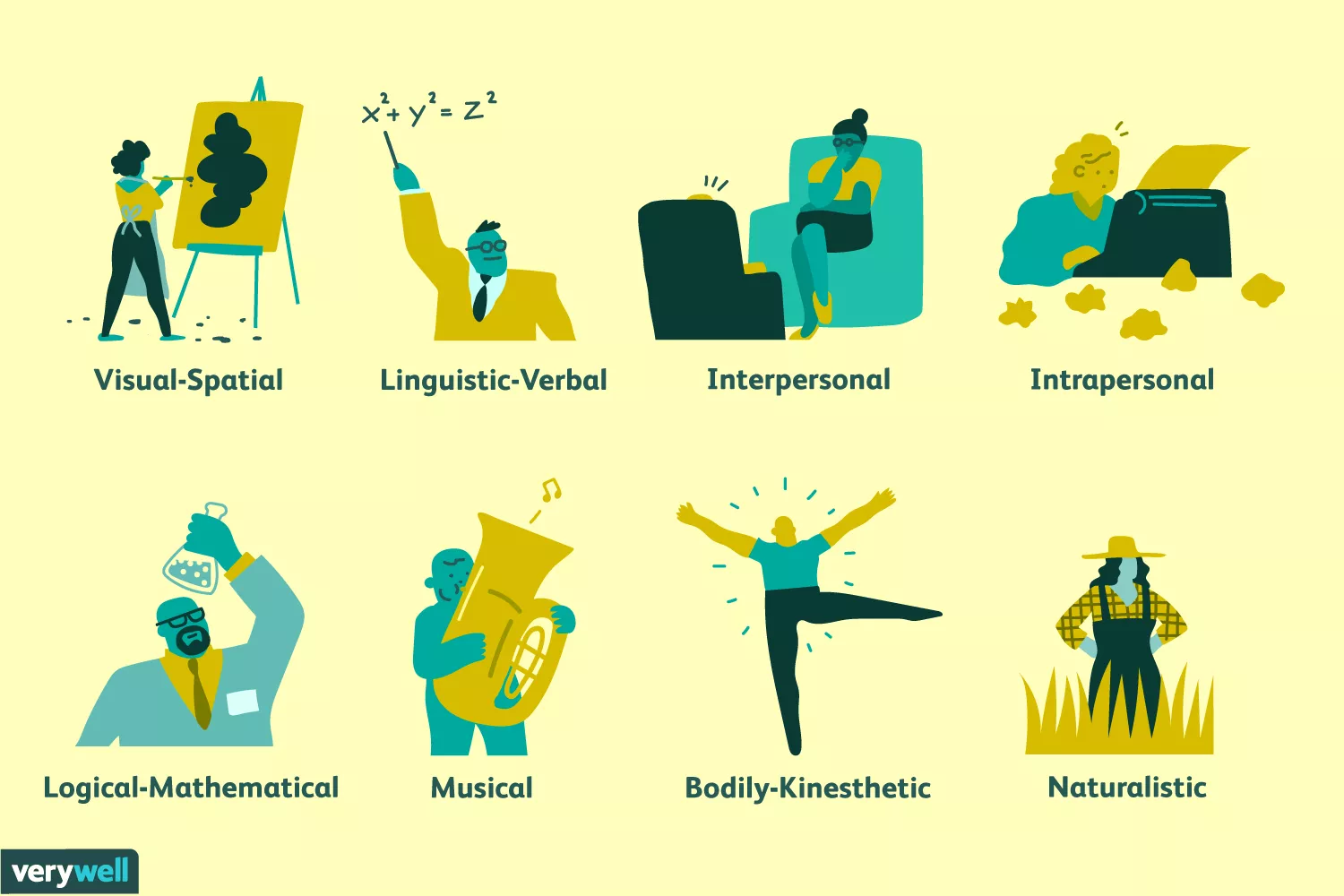
The theory of multiple intelligence was developed in 1983 by Dr. Howard Gardner, professor of education at Harvard University. It suggests that the traditional notion of intelligence, based on I.Q. testing, is far too limited. Instead, Dr. Gardner proposes eight different intelligence to account for a broader range of human potential in children and adults. These intelligences are:
- Visual-Spatial Intelligence
- Linguistic-Verbal Intelligence
- Logical-Mathematical Intelligence
- Bodily-Kinesthetic Intelligence
- Musical intelligence
- Interpersonal intelligence
- Intrapersonal intelligence
- Naturalist intelligence
- NOTE: Howard Gardner also suggested the possible addition of a ninth knows as “Existentialist intelligence“
- Visual-Spatial Intelligence
Strengths: Visual and spatial judgment
People who are strong in visual-spatial intelligence are good at visualizing things. These individuals are often good with directions as well as maps, charts, videos, and pictures.
Characteristics
Characteristics of visual-spatial intelligence include:
- Enjoys reading and writing
- Good at putting puzzles together
- Good at interpreting pictures, graphs, and charts
- Enjoys drawing, painting, and the visual arts
- Recognizes patterns easily
2. Linguistic-Verbal Intelligence
Strengths: Words, language, and writing
People who are strong in linguistic-verbal intelligence are able to use words well, both when writing and speaking. These individuals are typically very good at writing stories, memorizing information, and reading.
Characteristics
Characteristics of linguistic-verbal intelligence include:
- Good at remembering written and spoken information
- Enjoys reading and writing
- Good at debating or giving persuasive speeches
- Able to explain things well
- Often uses humor when telling stories
3. Logical-Mathematical Intelligence
Strengths: Analyzing problems and mathematical operations
People who are strong in logical-mathematical intelligence are good at reasoning, recognizing patterns, and logically analyzing problems. These individuals tend to think conceptually about numbers, relationships, and patterns.
Characteristics
Characteristics of logical-mathematical intelligence include:
- Excellent problem-solving skills
- Enjoys thinking about abstract ideas
- Likes conducting scientific experiments
- Good at solving complex computations
4. Bodily-Kinesthetic Intelligence
Strengths: Physical movement, motor control
Those who have high bodily-kinesthetic intelligence are said to be good at body movement, performing actions, and physical control. People who are strong in this area tend to have excellent hand-eye coordination and dexterity.
Characteristics
Characteristics of bodily-kinesthetic intelligence include:
- Good at dancing and sports
- Enjoys creating things with his or her hands
- Excellent physical coordination
- Tends to remember by doing, rather than hearing or seeing
5. Musical intelligence
Strengths: Rhythm and music
People who have strong musical intelligence are good at thinking in patterns, rhythms, and sounds. They have a strong appreciation for music and are often good at musical composition and performance.
Characteristics
Characteristics of musical intelligence include:
- Enjoys singing and playing musical instruments
- Recognizes musical patterns and tones easily
- Good at remembering songs and melodies
- Rich understanding of musical structure, rhythm, and notes
6. Interpersonal intelligence
Strengths: Understanding and relating to other people
Those who have strong interpersonal intelligence are good at understanding and interacting with other people. These individuals are skilled at assessing the emotions, motivations, desires, and intentions of those around them.
Characteristics
Characteristics of interpersonal intelligence include:
- Good at communicating verbally
- Skilled at nonverbal communication
- Sees situations from different perspectives
- Creates positive relationships with others
- Good at resolving conflict in groups
7. Intrapersonal intelligence
Strengths: Introspection and self-reflection
Individuals who are strong in intrapersonal intelligence are good at being aware of their own emotional states, feelings, and motivations. They tend to enjoy self-reflection and analysis, including daydreaming, exploring relationships with others, and assessing their personal strengths.
Characteristics
Characteristics of intrapersonal intelligence include:
- Good at analyzing his or her strengths and weaknesses
- Enjoys analyzing theories and ideas
- Excellent self-awareness
- Clearly understands the basis for his or her own motivations and feelings
8. Naturalist intelligence
Strengths: Finding patterns and relationships to nature
Naturalistic is the most recent addition to Gardner’s theory and has been met with more resistance than his original seven intelligences. According to Gardner, individuals who are high in this type of intelligence are more in tune with nature and are often interested in nurturing, exploring the environment, and learning about other species. These individuals are said to be highly aware of even subtle changes to their environments.
Characteristics
Characteristics of naturalistic intelligence include:
- Interested in subjects such as botany, biology, and zoology
- Good at categorizing and cataloging information easily
- May enjoy camping, gardening, hiking, and exploring the outdoors
- Doesn’t enjoy learning unfamiliar topics that have no connection to nature
 gardner.video.blog